Regarding the Recent US “Sale” of Mega-Bombs to Israel
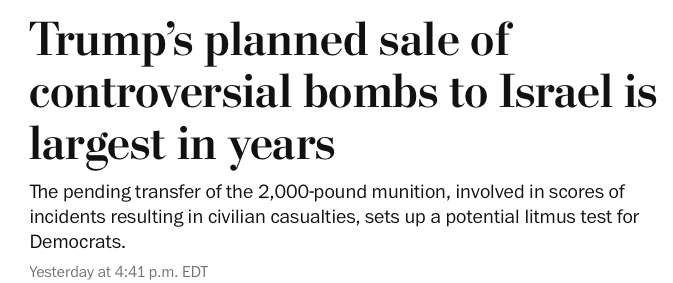
The Washington Post Headline: Trump’s planned sale of controversial bombs to Israel is largest in years. The pending transfer of the 2,000-pound munition, involved in scores of incidents resulting in civilian casualties, sets up a potential litmus test for Democrats."
Then, 4 paras down we see this: "Though described as a sale, the transaction is financed through a mechanism known as Foreign Military Financing, in which the United States provides the money that Israel uses to buy the weapons."
So headline says "sale," presumably for those readers who say "At least we are not giving Israel these massive weapons to finish off their genocide of Gaza." But then it's not really a sale. And it's for the genocide, even though the administration (according to the article) won't comment on "humanitarian concerns." They took that language through the laundry mat before publishing. One also has to wonder whether these bombs are especially useful because they vaporize bodies within 100 feet of the other center. This would leave much less evidence of dead bodies after Israel and the US use these bombs.
Here's another take on this sale of 40,000 bombs, each of them weighing 2,000 pounds by Tucker Carlson. This is another way of communicating the atrocious conduct of the United States and Israel. The U.S. is most definitely an accessory to this genocide, as well as an accessory to all of the crimes ("wars") Israel has coerced and bribed the US Congress and Presidents to fight for them. And none of these wars since and including Afghanistan have fought to defend the US (see below).
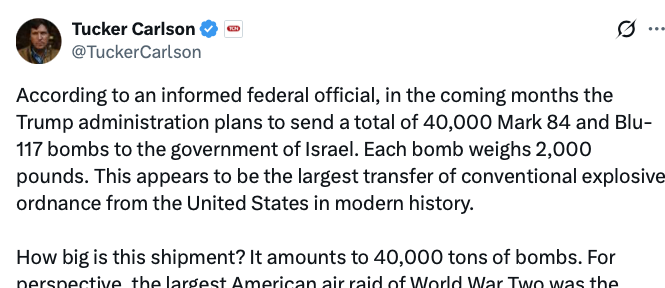
According to an informed federal official, in the coming months the Trump administration plans to send a total of 40,000 Mark 84 and Blu-117 bombs to the government of Israel. Each bomb weighs 2,000 pounds. This appears to be the largest transfer of conventional explosive ordnance from the United States in modern history.How big is this shipment? It amounts to 40,000 tons of bombs. For perspective, the largest American air raid of World War Two was the Eighth Air Force’s attack on Berlin in March of 1945. Combined, the 2,023 Allied aircraft involved dropped about 3,000 tons of bombs. That’s 7.5 percent of what Trump is sending to Israel. That same month, March of 1945, the US Army Air Forces began the single most destructive bombing raid in human history, Operation Meetinghouse over Tokyo. More than 100,000 Japanese civilians were killed. By the end of that operation, the US had dropped 1,600 tons of bombs. That’s four percent of what Trump is sending to Israel. World War Two ended five months later, when the US dropped an atomic bomb on the city of Hiroshima. The shipment Trump is sending to Israel amounts to more than three times the destructive power of that nuclear explosion. There is no precedent for what the Trump administration is doing.
[More . . . ]